ABOUT THE PLATFORM
ABOUT THE PLATFORM
Building Canada’s Next Generation of Learning Health System Leaders
Building Canada’s Next Generation of Learning Health System Leaders
Our training platform is designed to strengthen the Canadian Institutes of Health Research (CIHR) Health System Impact (HSI) Program by enhancing training, capacity building, and networking for doctoral fellows, postdoctoral fellows, early career researchers, and mentors.
We equip HSI fellows, alumni, and early career embedded researchers with the core competencies and connections they need to lead change. Through collaborative learning, skill development, and knowledge sharing, we are building a pan-Canadian community of embedded researchers—one that works across disciplines, sectors, and regions.
By fostering collaboration and practical skills, this platform supports the creation of transformative, agile, and responsive Learning Health Systems (LHS) and other organizations that share LHS values. Our work is guided by the Quintuple Aim: improving health outcomes, enhancing patient and provider experiences, advancing equity, and driving sustainable system performance.
Mission & Values
Our mission is to train, foster, and advance a pan-Canadian community of embedded researchers and learning health systems leaders that empowers, activates, and accelerates equitable, just, and sustainable learning health systems.
Our Values
- Equity: Redressing historical and ongoing colonialism and structural racism and discrimination in health system and research ecosystems via leadership by and inclusion of people with lived experience of exclusion.
- Co-production: Partnering with communities, practitioners, and policy makers to co-design and implement training and professional development, research activities and health system change.
- Relevance: Creating learning opportunities and generating applied research that responds to urgent and emerging community, health system, and policy priorities.
- Integrity: Upholding ethical standards and transparency in all training activities, research initiatives and partnerships.
- Actionability: Providing experiential learning and producing evidence that leads to meaningful, sustainable changes in health systems.
- Respect: Honoring local knowledge, cultural contexts, and the lived experiences of all partners and community members.
These values form the foundation of the HSITP’s pan-Canadian learning community and guide our efforts to strengthen Canada’s health system research and leadership capacity.
One Platform, Three Streams of Training and Networking
The Health System Impact Training Platform offers three interconnected streams of training and networking designed to meet the diverse needs of fellows, early career researchers (ECRs), alumni, mentors, and supervisors. Each stream provides structured opportunities for learning, leadership, and collaboration, creating a supportive national community that strengthens capacity for high-performing, agile, and responsive health systems.
Learn more about each of our Streams:
Stream I
Excellence and Innovation in Training
Stream I focuses on delivering high-quality, adaptive training that strengthens the professional development of HSI fellows, embedded ECRs, and alumni. Grounded in the HSPR Enriched Core Competency Framework and informed by continuous evaluation, this stream ensures participants gain the skills and expertise needed to thrive in diverse health system contexts.
What Stream I Does
- Designs and delivers flexible, adaptive curriculum aligned with HSPR core competencies.
- Builds professional and research skills through innovative, problem-based learning.
- Creates opportunities for collaboration and peer learning across fellows, ECRs, alumni, and mentors.
- Ensures training is responsive to emerging health system priorities and prepares participants for leadership.
Stream ll
Excellence and Innovation in ECR Career Development
Stream II provides targeted career development support for HSI early career researchers (ECRs), helping them strengthen their capacity as leaders and maximize their impact within health systems. Built on insights from a national needs assessment and feedback from participants, this stream tailors training and mentorship to the diverse career paths of ECRs.
What Stream II Does
- Supports leadership development, mentorship, and career adaptability for embedded ECRs.
- Provides tools for navigating academic, policy, and health system environments.
- Builds confidence and capacity in areas such as collaboration, knowledge translation, and communication.
- Fosters connections with peers, mentors, and system leaders to expand professional networks.
Stream lll
Excellence and Innovation in Mentorship
Stream III strengthens the mentorship culture within the HSI community by supporting health system mentors, academic supervisors, alumni, and ECRs in building effective, equitable, and sustainable mentorship practices. This stream ensures that mentorship is a cornerstone of professional growth and a driver of long-term program success.
What Stream IIl Does
- Promotes best practices in mentorship through shared learning, workshops, and knowledge exchange.
- Builds the capacity of health system mentors and academic supervisors to support fellows in advancing LHSs.
- Creates opportunities for ECRs and alumni to develop as future mentors and leaders.
- Recognizes and celebrates exceptional mentorship to foster a sustainable culture of support.
Stream 1
Excellence and Innovation in Training
Stream I focuses on delivering high-quality, adaptive training that strengthens the professional development of HSI fellows, embedded ECRs, and alumni. Grounded in the HSPR Enriched Core Competency Framework and informed by continuous evaluation, this stream ensures participants gain the skills and expertise needed to thrive in diverse health system contexts.
Stream 2
Excellence and Innovation in ECR Career Development
Stream II provides targeted career development support for HSI early career researchers (ECRs), helping them strengthen their capacity as leaders and maximize their impact within health systems. Built on insights from a national needs assessment and feedback from participants, this stream tailors training and mentorship to the diverse career paths of ECRs.
Stream lll
Excellence and Innovation in Mentorship
Stream III strengthens the mentorship culture within the HSI community by supporting health system mentors, academic supervisors, alumni, and ECRs in building effective, equitable, and sustainable mentorship practices. This stream ensures that mentorship is a cornerstone of professional growth and a driver of long-term program success.
What Stream 1 Does
- Designs and delivers flexible, adaptive curriculum aligned with HSPR core competencies.
- Builds professional and research skills through innovative, problem-based learning.
- Creates opportunities for collaboration and peer learning across fellows, ECRs, alumni, and mentors.
- Ensures training is responsive to emerging health system priorities and prepares participants for leadership.
What Stream 3 Does
- Supports leadership development, mentorship, and career adaptability for embedded ECRs.
- Provides tools for navigating academic, policy, and health system environments.
- Builds confidence and capacity in areas such as collaboration, knowledge translation, and communication.
- Fosters connections with peers, mentors, and system leaders to expand professional networks.
What Stream 3 Does
- Promotes best practices in mentorship through shared learning, workshops, and knowledge exchange.
- Builds the capacity of health system mentors and academic supervisors to support fellows in advancing LHSs.
- Creates opportunities for ECRs and alumni to develop as future mentors and leaders.
- Recognizes and celebrates exceptional mentorship to foster a sustainable culture of support.
Together, these streams ensure that HSITP is not just a training program but a national platform for building Canada’s next generation of health system leaders.
Core Competencies: Our Guiding Framework
Transversal Domains:
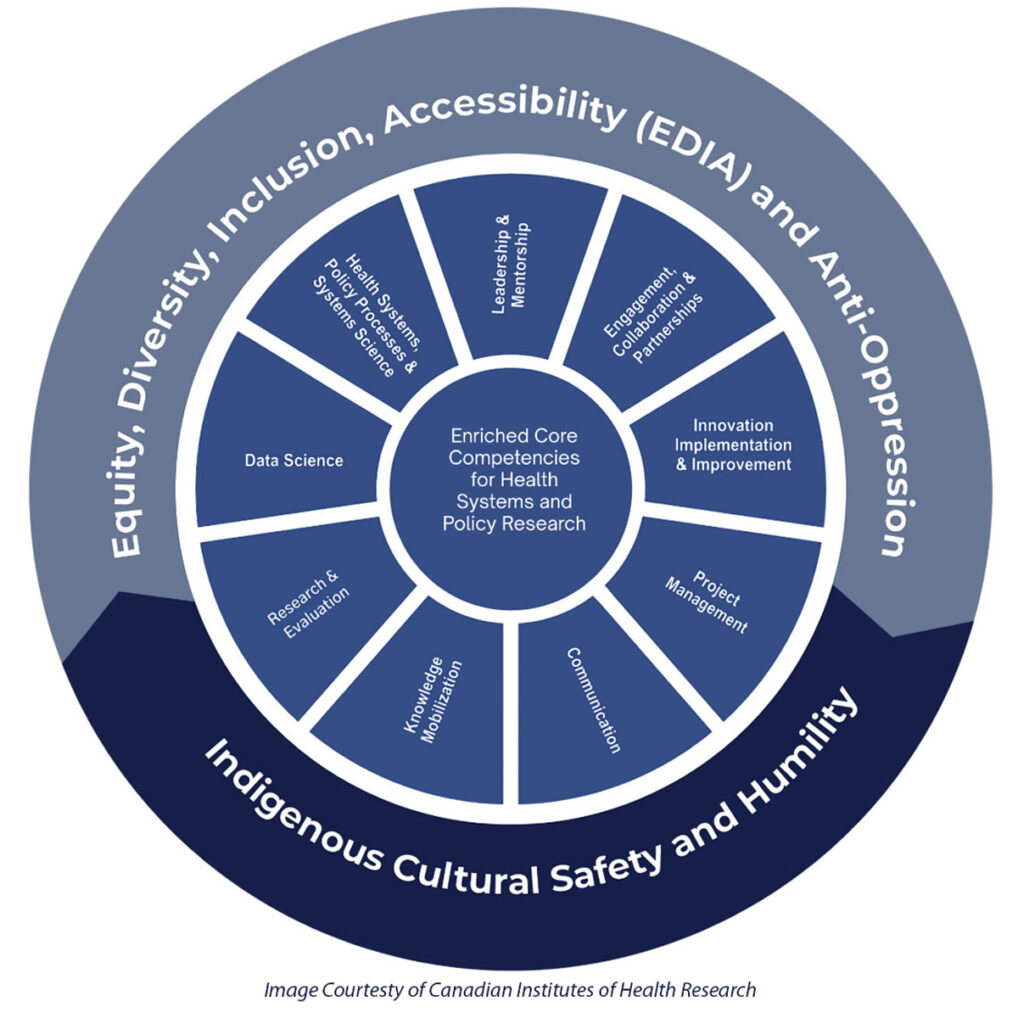
- Equity, Diversity, Inclusion, Accessibility & Anti-Oppression: applying EDIA principles and intersectionality in research and practice to advance health equity and anti-oppression.
- Indigenous Cultural Safety & Humility: engaging in respectful, culturally safe research and relationships with Indigenous Peoples to address anti-Indigenous racism.
What are the Core Competencies ?
The HSITP is firmly rooted in the Refreshed Enriched Core Competency Framework for Health Systems & Policy Research, ensuring that everything we do—curriculum design, professional development, mentorship, and evaluation—is aligned with the essential skills needed for impact.
We commit to equipping our participants with abilities in leadership, evidence-informed practice, systems thinking, innovation, communication, equity, and more, so that they are ready not only to conduct excellent research, but to drive real, positive change in health systems.
Core Competencies:
- Leadership & Mentorship: leading self and others, fostering collaboration, mentoring emerging leaders, and creating cultures of continuous learning.
- Innovation, Implementation & Improvement: creating, adapting, and implementing new approaches that advance health system learning and improvement.
- Engagement, Collaboration & Partnership: building inclusive, culturally safe collaborations with patients, communities, providers, and partners.
- Project Management: planning, coordinating, and managing projects and programs from conception to dissemination, while anticipating and mitigating risks.
- Communication: conveying complex evidence clearly, effectively, and with impact across diverse audiences.
- Knowledge Mobilization: co-producing relevant research, integrating diverse forms of evidence, and supporting the uptake of research in policy and practice.
- Health Systems, Policy Processes & Systems Science: understanding how health systems operate and decisions are made, and applying systems science to inform local and global contexts.
- Research & Evaluation: asking meaningful questions, applying appropriate methods, evaluating interventions in complex contexts, and developing evidence-informed solutions.
- Data Science: generating insights from diverse data sources (administrative, electronic, and lived experience) to address health system challenges and improve outcomes.
What are the Core Competencies ?
The HSITP is firmly rooted in the Refreshed Enriched Core Competency Framework for Health Systems & Policy Research, ensuring that everything we do—curriculum design, professional development, mentorship, and evaluation—is aligned with the essential skills needed for impact.
We commit to equipping our participants with abilities in leadership, evidence-informed practice, systems thinking, innovation, communication, equity, and more, so that they are ready not only to conduct excellent research, but to drive real, positive change in health systems.
Transversal Domains:
- Equity, Diversity, Inclusion, Accessibility & Anti-Oppression – applying EDIA principles and intersectionality in research and practice to advance health equity and anti-oppression.
- Indigenous Cultural Safety & Humility – engaging in respectful, culturally safe research and relationships with Indigenous Peoples to address anti-Indigenous racism.
Core Competencies:
- Leadership & Mentorship – leading self and others, fostering collaboration, mentoring emerging leaders, and creating cultures of continuous learning.
- Innovation, Implementation & Improvement – creating, adapting, and implementing new approaches that advance health system learning and improvement.
- Engagement, Collaboration & Partnership – building inclusive, culturally safe collaborations with patients, communities, providers, and partners.
- Project Management – planning, coordinating, and managing projects and programs from conception to dissemination, while anticipating and mitigating risks.
- Communication – conveying complex evidence clearly, effectively, and with impact across diverse audiences.
- Knowledge Mobilization – co-producing relevant research, integrating diverse forms of evidence, and supporting the uptake of research in policy and practice.
- Health Systems, Policy Processes & Systems Science – understanding how health systems operate and decisions are made, and applying systems science to inform local and global contexts.
- Research & Evaluation – asking meaningful questions, applying appropriate methods, evaluating interventions in complex contexts, and developing evidence-informed solutions.
- Data Science – generating insights from diverse data sources (administrative, electronic, and lived experience) to address health system challenges and improve outcomes.
Curious about how the core competencies were developed?
Learn More: CIHR’s Health System Impact Program
Strengthening the CIHR Health System Impact Program
The HSITP is specifically designed to support and strengthen the Canadian Institutes of Health Research (CIHR) Health System Impact Fellowship (HSI) program, one of Canada’s flagship initiatives for training the next generation of health system researchers and leaders.
Through this collaboration, HSITP enhances the HSI program by:
- Offering a structured training platform for fellows, alumni and mentors.
- Expanding networking opportunities across regions and sectors.
- Providing mentorship, leadership development, and capacity-building resources.
- Creating community: fostering collaboration and shared learning across the HSI network.